
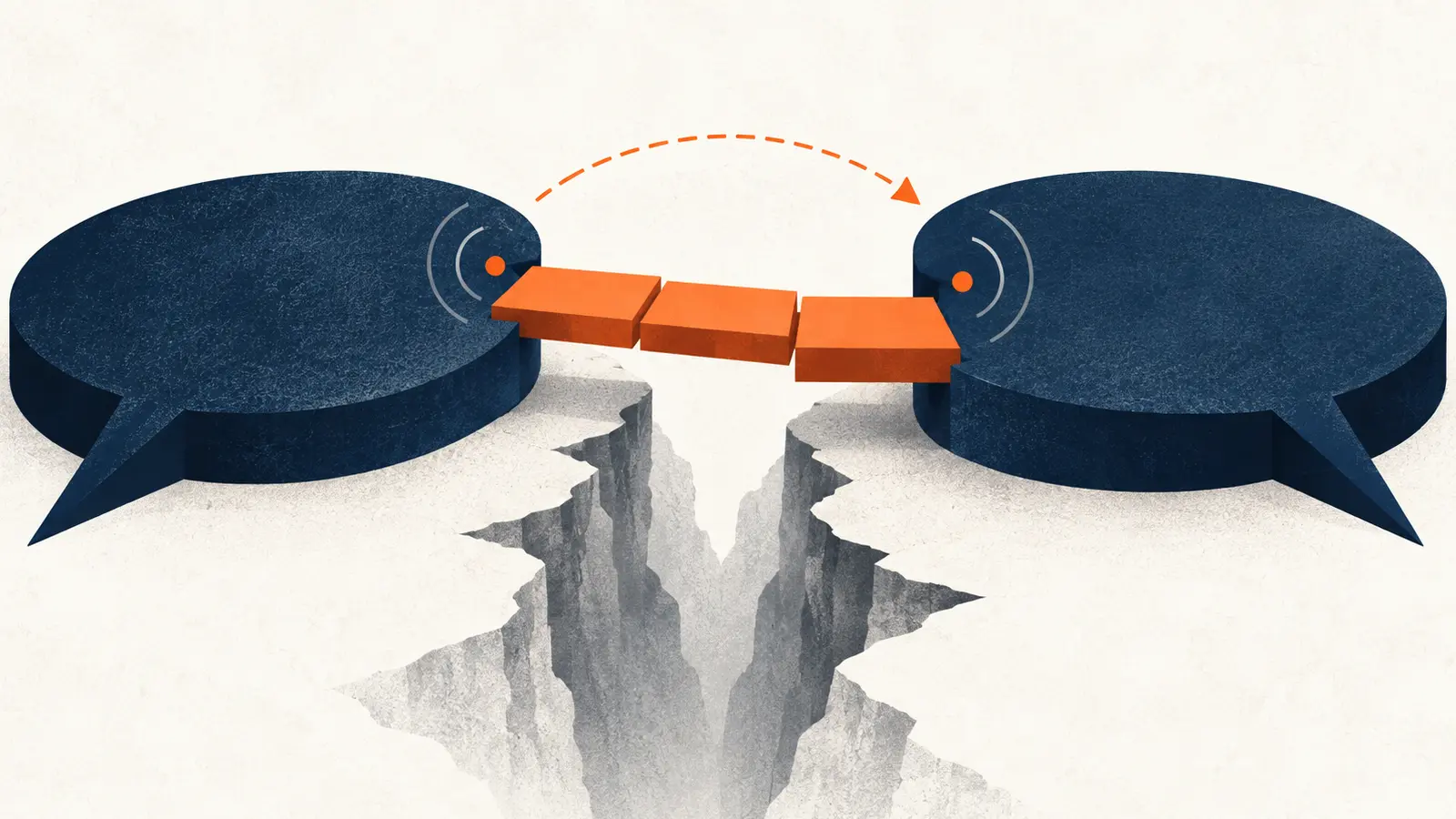
Many programmes teach managers a conversation model, run one role-play and end with a commitment to be braver. That can improve awareness. It rarely proves that a manager can address missed standards, strained working relationships or defensiveness when the stakes are real.
The design challenge is to turn a difficult conversation from a topic people understand into a behaviour they can perform under pressure. That means giving managers a safe place to practise, then building a bridge into the actual workplace.
This guide is for HR, L&D and people leaders designing or selecting difficult conversations training for managers in Singapore and across Asia. It focuses on capability design, not employment-law advice. Your policies, local requirements and HR guidance should define formal processes and escalation routes.
Why this capability deserves deliberate practice
Difficult conversations are not a niche management event. They sit inside everyday performance, accountability, collaboration and change. A 2025 Acas survey of 4,558 working-age people in Great Britain found that 44% had experienced conflict at work in the previous year. Capability and performance were the most common conflict topic, and discussions with managers or the other person were the most common ways people tried to resolve conflict. The geography matters—these are not Singapore prevalence figures—but the findings illustrate why informal manager conversations are an operational capability, not just a communication preference.
Singapore's Institute for Adult Learning describes feedback as a two-way process that can help workers understand expected performance and improve expertise over time. Its practitioner guidance emphasises feedback that is specific, constructive, prompt and grounded in the supervisor's observations. SEED's interpretation is practical: managers need to learn how to be both candid and curious. Clarity without listening becomes a verdict; listening without clarity leaves the issue unresolved.
That is also why a script is insufficient. A manager may know the opening sentence and still struggle when the other person disagrees, becomes emotional, introduces new evidence or asks what will happen next.
Start with the decisions managers actually face
Do not begin by asking which conversation framework to teach. Begin by identifying the moments managers avoid, delay or handle inconsistently. Interview managers, their managers and HR partners; review anonymised patterns from employee relations, engagement feedback and performance processes; and separate skill gaps from process or workload problems.
Useful questions include:
- Which conversations have the greatest cost when they happen late?
- Where do managers confuse a clear standard with a personal judgement?
- Which situations require informal resolution, and which must move into a formal process?
- What does a capable manager do before, during and after the conversation?
- What support is available if new information changes the nature of the issue?
If the organisation cannot answer these questions, the learning need is not yet ready for a generic workshop. Use a structured Training Needs Diagnostic or review how to identify manager capability gaps before committing to content.
Use the conversation-to-escalation decision table
Managers need confidence, but they also need boundaries. Training should help them distinguish an everyday management conversation from an issue requiring advice, formal process or immediate escalation. Adapt the table below to your own policies and jurisdiction with HR or legal input.
| Situation | Manager's immediate role | Training emphasis | Boundary to make explicit |
|---|---|---|---|
| One missed expectation or unhelpful behaviour | Address it promptly, using specific observations and a clear standard | Evidence, impact, listening and an agreed next step | Do not present assumptions or hearsay as fact |
| Repeated performance concern | Clarify the pattern, support required and follow-up | Consistency, documentation and fair process | Check policy and involve HR at the defined point |
| Interpersonal tension between colleagues | Understand perspectives and support constructive dialogue where appropriate | Neutral questions, interests and workable agreements | Do not force informal resolution where it is unsafe or unsuitable |
| Wellbeing or personal disclosure | Listen, clarify immediate support and connect the person to appropriate resources | Care, boundaries and referral | Managers should not diagnose or promise confidentiality they cannot keep |
| Possible harassment, discrimination, misconduct or safety risk | Take the concern seriously and follow the organisation's reporting route | Recognition, response and escalation | Do not treat it as an ordinary coaching conversation |
This table is a design aid, not a substitute for policy. Build training scenarios around the grey areas managers genuinely face, then make the escalation rule visible before practice begins.
Build a five-step practice ladder
A single high-stakes role-play often tests confidence more than it builds skill. Instead, increase realism in stages. Each step should preserve the same core behaviour while adding one new demand.
Diagnose
Choose the right conversation and boundary.
Prepare
Separate observation, impact, standard and assumption.
Open
Practise a concise opening and first question.
Respond
Rehearse disagreement, emotion and new evidence.
Apply
Use the skill at work, follow up and debrief.
Behaviour-modelling research supports this emphasis on visible examples, practice and transfer conditions. A meta-analysis of 117 studies found the strongest skill development when learning points were clear and training time was sufficient. Transfer was stronger when programmes used both effective and ineffective models, participant-generated scenarios, goal setting and workplace reinforcement. That does not mean every programme must copy one method. It does mean that showing a model without letting managers practise, adapt and receive reinforcement leaves value on the table.
Teach a preparation method, not a perfect script
Managers benefit from a simple structure they can remember. The structure should organise judgement rather than prescribe identical words.
- Purpose: What needs to be different after this conversation? Is the goal clarity, learning, a decision, an agreement or escalation?
- Observation: What did you directly see, hear or receive? Remove labels such as “uncommitted” and describe the observable event.
- Impact: What consequence did it create for work, customers, the team or the individual? Do not exaggerate.
- Standard: What expectation, agreement or required outcome applies? Check that the person could reasonably have known it.
- Perspective: What question will help you understand missing context? Plan to listen for information that may change your diagnosis.
- Next step: What agreement, support, documentation or escalation may be needed? Avoid ending with a vague request to “do better”.
For example, replace “Your attitude in meetings is becoming a problem” with: “In the last two project meetings, you spoke over Mei before she finished presenting the risk. The group then moved on without deciding how to handle it. Our expectation is that concerns are heard and resolved before a decision. What was happening from your perspective?”
The example is not a universal script. Its value is in the sequence: observable evidence, work impact, standard and a genuine question.
Design scenarios that create useful difficulty
The first scenarios should be familiar enough for managers to focus on the behaviour. Later rounds can introduce realistic uncertainty. A strong scenario pack varies four things:
- Conversation type: feedback, missed performance, behaviour, workload, conflict or change.
- Response: agreement, surprise, disagreement, emotion, counter-evidence or silence.
- Context: hybrid work, cross-cultural team, senior specialist, new manager or matrix relationship.
- Boundary: an issue the manager can resolve, one requiring advice, or one requiring immediate escalation.
Use anonymised composite situations rather than reproducing a real employee case. Invite participants to bring the pattern of a conversation without names or confidential details. Avoid asking colleagues to reenact unresolved personal disputes in an open classroom.
For a first-time manager cohort, the sequence may begin with clear feedback and only later add resistance. For experienced leaders, a better challenge may be a conversation where the manager's initial diagnosis is incomplete. The point is not theatrical realism. It is practising the decisions and behaviours that matter.
Give feedback on observable behaviour
“That felt empathetic” is not enough. Use a short rubric so observers can point to evidence and the manager knows what to try next.
| Behaviour | What an observer can see or hear | Common failure mode |
|---|---|---|
| Frames the purpose | States why the conversation is happening and what outcome is needed | A long preamble that hides the issue |
| Uses grounded evidence | Names specific observations and distinguishes them from interpretation | Labels, absolutes or second-hand claims |
| Listens and tests | Asks a genuine question, reflects key information and updates the diagnosis when needed | Waiting to deliver the next scripted line |
| Maintains clarity | Acknowledges emotion or disagreement without withdrawing the standard | Becoming defensive or softening the message until it is unclear |
| Closes the loop | Confirms actions, ownership, support, timing and follow-up | Ending on goodwill without an agreement |
| Uses the right boundary | Pauses, documents or escalates when the issue moves beyond an informal conversation | Trying to solve every situation alone |
Keep the feedback focused. After each round, ask the manager to self-assess first, give one piece of evidence-based feedback, and let them repeat the difficult moment. A second attempt turns feedback into behaviour while the learning is still immediate.
Connect the workshop to manager practice
IAL's workplace-learning guidance stresses intentional learning through work and includes demonstrations, feedback and coaching among practical workplace methods. For difficult conversations, the implication is direct: the classroom should prepare the attempt, but the workplace must complete the learning loop.
A practical transfer plan can include:
- a real conversation selected before or during the programme;
- a preparation worksheet completed with confidential details kept out of shared systems;
- a pre-conversation check-in with the manager's manager or HR partner where appropriate;
- a follow-up date agreed before the conversation happens;
- a short debrief focused on what the manager noticed, did and will change;
- a second application in a different situation within four to six weeks.
Managers' managers need a role too. They should avoid taking over the conversation, while making time for preparation and observing follow-through. If the organisation is also building a broader manager curriculum, connect this practice to the first-time manager programme, the Manager Development Plan Template and guidance on making training stick after a workshop.
Measure behaviour before confidence
Confidence is useful when it supports action, but confidence alone is not evidence of capability. Collect a small set of signals that match the original performance problem.
Before training, establish a baseline through scenario observation, manager self-assessment and manager-of-manager input. After training, look for:
- Preparation quality: managers arrive with specific observations, a clear purpose and a suitable boundary.
- Practice quality: rubric scores improve across repeated attempts, especially under resistance.
- Application: managers complete the agreed workplace conversation and follow-up.
- Consistency: managers use the behaviour again in another context.
- Operational evidence: relevant issues are addressed earlier, expectations are clearer or escalation is more appropriate.
Interpret operational measures carefully. Fewer HR cases could indicate earlier resolution—or under-reporting. More documented conversations could indicate stronger management—or a temporary increase as managers stop avoiding issues. Pair numbers with qualitative review and use SEED's training measurement guide to connect evidence to a specific decision.
Common design mistakes
Teaching a framework without practising disruption
A conversation rarely follows the model neatly. Add resistance, emotion and new information only after managers can perform the basics.
Using one generic scenario for everyone
A retail supervisor, regional functional leader and startup founder face different authority, pace and stakeholder dynamics. Preserve the behaviour criteria while adapting context.
Rewarding polish over clarity
A warm tone cannot compensate for a hidden message. Give feedback on whether the person understood the issue, standard and next step.
Treating every issue as an informal conversation
Training must make escalation boundaries explicit. Managers should know when to pause, seek advice and follow formal policy.
Ending at the workshop door
Without a real application, follow-up and manager support, practice remains disconnected from work. Build the transfer mechanism into the programme brief.
Design checklist for HR and L&D
- The target conversation types come from real organisational needs, not a generic topic list.
- Formal-process and escalation boundaries have been reviewed with the appropriate internal experts.
- Learning outcomes describe observable manager behaviour.
- The programme shows both effective and ineffective examples.
- Managers practise more than once and receive evidence-based feedback.
- Scenarios reflect relevant roles, cultures, authority levels and work settings.
- Participants can repeat a difficult moment after feedback.
- A real workplace application and follow-up date are agreed.
- Managers' managers or HR partners know how to support without taking over.
- Evaluation includes behaviour and application evidence, not only satisfaction or confidence.
When to use a workshop—and when to design a journey
A focused workshop or masterclass can work when managers need a shared language, a small set of behaviours and practice around a defined conversation type. It is less likely to be enough when the organisation needs consistency across several manager populations, new policy boundaries, sustained behaviour change or evidence of workplace application.
In those cases, use a learning journey: diagnosis, manager briefing, live practice, workplace application, coaching or peer reflection, and follow-up evidence. SEED's Training Programme Design service is designed around that connection between learning, practice and business capability.
If you are deciding which format fits your manager population, talk to SEED Academy about the conversations managers need to handle and the workplace behaviour you need to see.
Sources and interpretation
The design recommendations in this article are SEED Academy's interpretation of the following evidence and practitioner guidance:
- Acas, How prevalent is individual conflict at work in Great Britain in 2025? Survey fieldwork took place in August–September 2025; the report notes a correction on 7 January 2026.
- Acas, Guide to challenging conversations. Practical guidance for employers and line managers; published July 2014.
- Taylor, Russ-Eft and Chan, A Meta-Analytic Review of Behavior Modeling Training, Journal of Applied Psychology, 2005.
- Institute for Adult Learning Singapore, Supervisors: Key to Unlocking Sense-making at the Workplace.
- Institute for Adult Learning Singapore, Embracing Workplace Learning. The current course page was reviewed in September 2026.
Evidence note: The Acas prevalence data is from Great Britain and is used to illustrate the scale and handling of workplace conflict in that context, not to claim a Singapore prevalence rate.