
A workshop can create clarity, confidence and shared language. It cannot control what happens when participants return to a full inbox, an unchanged meeting rhythm and a manager who does not know what they were asked to practise.
That gap between learning and use is the learning-transfer problem. The practical response is not to add more content. It is to design a short bridge from the learning room into real work.
Start with one behaviour, not a broad ambition
“Communicate better” is difficult to practise and almost impossible to observe. A useful transfer goal describes what someone will do, in which situation and what evidence another person could notice.
For example: In the next project meeting, the manager will frame the decision, invite one dissenting view and close with a named owner and deadline. That gives the participant a situation, a sequence and an observable standard.
If a programme covers several capabilities, choose one priority behaviour for the first 30 days. Depth creates usable evidence; a long action list usually creates administrative completion.
What the evidence says about learning transfer
The classic Baldwin and Ford review organised transfer around three connected influences: the learner, the training design and the work environment. A later meta-analysis of 89 empirical studies found positive relationships between transfer and factors including motivation and a supportive work environment; these relationships were especially important for open skills such as leadership development.
The implication is straightforward: even a strong workshop is only one part of the system. The CDC's quality-training evidence reference highlights the period immediately after training and points to follow-up, feedback and job aids as practical transfer supports. In Singapore, the Institute for Adult Learning's Centre for Workplace and Learning Innovation similarly emphasises integrating learning across workplaces.
SEED's interpretation is to treat transfer as a designed sequence: practise, apply, observe, adjust and reinforce.
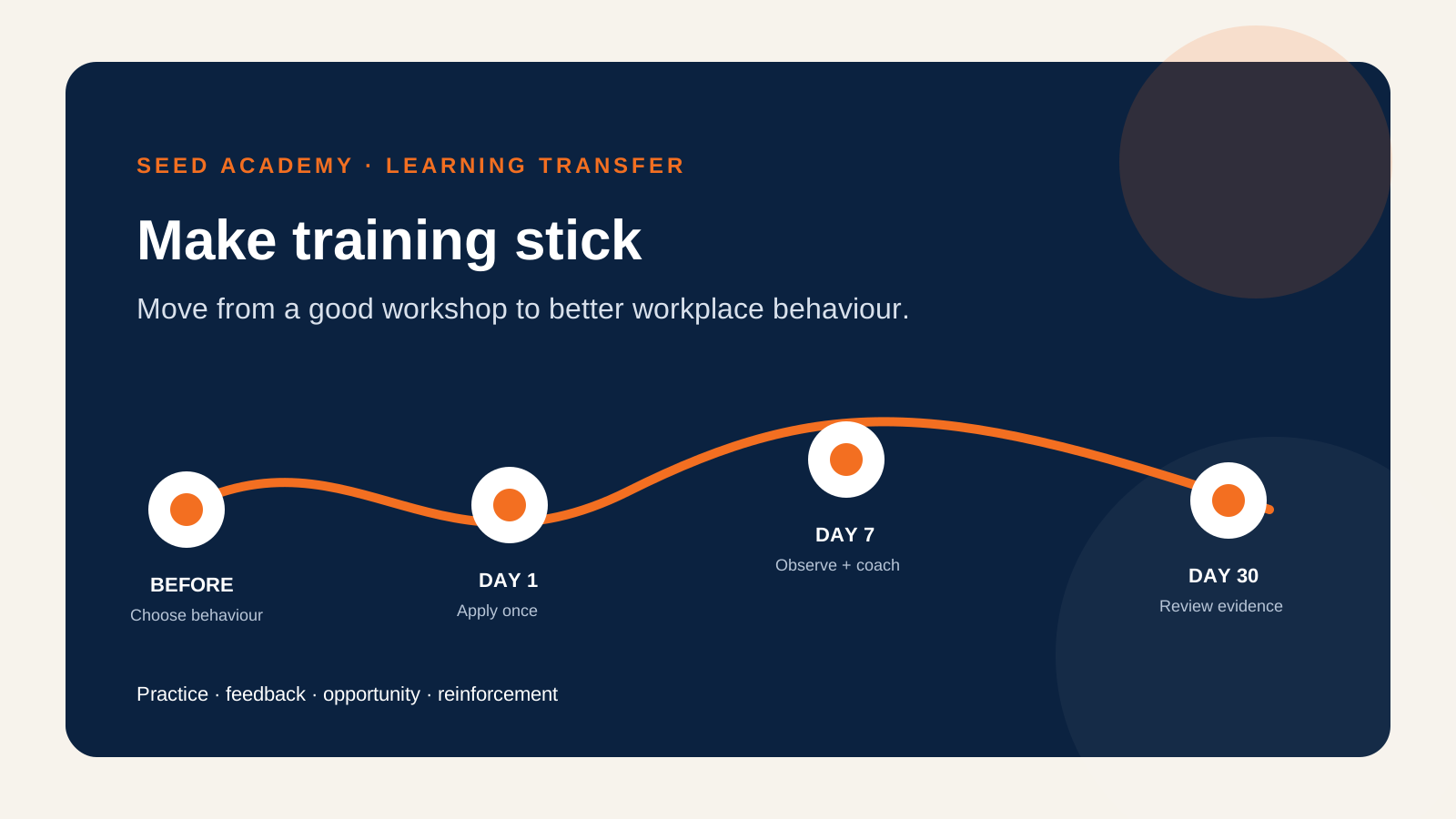
The 30-day learning transfer map
Before the workshop ends
Name one behaviour, one real situation and one evidence source.
Within three days
Use the behaviour once in live work and capture what happened.
After one week
Get observation, feedback or coaching; then adjust the next attempt.
At 30 days
Review repeated use, quality and the next reinforcement decision.
Who does what
| Timing | Participant | Manager / L&D | Useful evidence |
|---|---|---|---|
| Before the session ends | Choose one workplace situation and write the intended behaviour. | Confirm that the situation is relevant and safe to practise. | A specific action statement, not a topic list. |
| Days 1–3 | Make the first attempt while the learning is still accessible. | Protect the opportunity; avoid taking the task back. | A work product, meeting note or brief reflection. |
| Day 7 | Explain what worked, what felt difficult and what will change. | Ask for an example and give behaviour-specific feedback. | Observed behaviour plus one adjustment. |
| Day 14 | Apply the behaviour in a second, slightly different situation. | Coach only where needed; do not turn follow-up into surveillance. | Evidence of use across more than one context. |
| Day 30 | Review whether the behaviour is becoming repeatable. | Decide whether to reinforce, extend, redesign or stop. | A decision supported by examples and relevant indicators. |
A worked example: difficult feedback
Suppose a new-manager workshop teaches a feedback structure. “Use the model this month” is too vague. A stronger transfer plan looks like this:
- Situation: one overdue performance conversation already on the manager's calendar.
- Behaviour: state the observed action, explain its impact, ask for the employee's view and agree on the next step.
- First attempt: within three working days.
- Evidence: the manager records the agreed next step—not the confidential conversation.
- Reinforcement: the manager's manager asks two questions at the next one-to-one: “What did you observe?” and “What will you do differently next time?”
- 30-day review: look for two or three completed conversations, clearer follow-through and fewer avoidable escalations. Do not claim that training alone caused a wider business result.
This keeps the follow-up practical while respecting confidentiality. It also gives HR and L&D evidence that is more meaningful than attendance or satisfaction alone.
Choose reinforcement to match the risk
More follow-up is not automatically better. Match the support to the complexity of the behaviour, the consequences of getting it wrong and how often participants can practise.
| Use this approach | When it fits | Trade-off |
|---|---|---|
| Prompt + job aid | The behaviour is simple, frequent and low-risk. | Efficient, but easy to ignore if the work environment does not cue use. |
| Manager check-in | The behaviour is observable and the manager can create practice opportunities. | Scales well, but depends on manager capability and consistency. |
| Peer practice circle | Participants face related challenges and can learn from examples. | Builds shared accountability, but needs clear boundaries and facilitation. |
| Coaching | The situation is high-stakes, personal or strongly context-dependent. | Creates depth, but takes more time and should not be used for every participant by default. |
For a wider programme, combine a shared foundation with targeted support. A workshop can create common language; coaching or manager conversations can help people apply it to different teams and decisions. See SEED's comparison of workshops and coaching for a format decision guide.
Measure transfer without creating a reporting burden
Start with the decision the evidence needs to support. Do you need to know whether participants tried the behaviour, whether the quality improved or whether the programme should be scaled?
A simple evidence chain is usually enough:
- Opportunity: Did the participant encounter a relevant situation?
- Application: Did they use the target behaviour?
- Quality: What did an observer, work product or outcome show?
- Adjustment: What changed on the next attempt?
- Decision: Should the organisation reinforce, extend, redesign or stop?
Use self-report when it is the only practical source, but do not treat confidence as behaviour. Where possible, pair it with manager observation, a work product or a relevant operating indicator. SEED's guide on measuring training effectiveness explains how to separate participant experience, learning, application and business evidence.
Common transfer mistakes
- Waiting a month for the first application. Design a usable opportunity within days.
- Giving every participant the same assignment. Keep the behaviour standard shared, but let the work situation reflect role and context.
- Asking managers to “support the learning” without a task. Give them one observation prompt and one conversation date.
- Collecting too much data. Evidence should help a decision, not prove that the programme team was busy.
- Ignoring system barriers. If workload, incentives or decision rights punish the new behaviour, another reminder will not solve the problem.
A pre-launch checklist for HR and L&D
- The target behaviour is observable.
- Participants have a real opportunity to use it within three working days.
- Managers know the behaviour and the follow-up question.
- A job aid or prompt is available at the moment of use.
- The first review date is already scheduled.
- Evidence sources and confidentiality boundaries are clear.
- There is a decision rule for reinforce, extend, redesign or stop.
You can turn these choices into a participant-ready plan with SEED's Post-Workshop Action Plan. For multi-module or regional initiatives, the broader leadership programme design guide shows how to connect diagnosis, practice, application and measurement from the start.
Make application part of the design
The best time to solve the post-workshop problem is before the workshop is commissioned. Clarify the work situation, behaviour, practice conditions, manager role and evidence while the programme is being designed.
That is how learning becomes capability: not because participants remember every slide, but because they can use a better behaviour when the work requires it. If your organisation is planning a programme where application matters, explore SEED Academy's Training Programme Design approach or start a capability conversation.
Sources
- Baldwin, T. T. & Ford, J. K. (1988), Transfer of Training: A Review and Directions for Future Research.
- Blume, B. D., Ford, J. K., Baldwin, T. T. & Huang, J. L. (2010), Transfer of Training: A Meta-Analytic Review.
- Grossman, R. & Salas, E. (2011), The Transfer of Training: What Really Matters.
- CDC, Quality Training Standards reference list, reviewed 19 December 2024.
- Institute for Adult Learning Singapore, Centre for Workplace and Learning Innovation, accessed 26 September 2026.